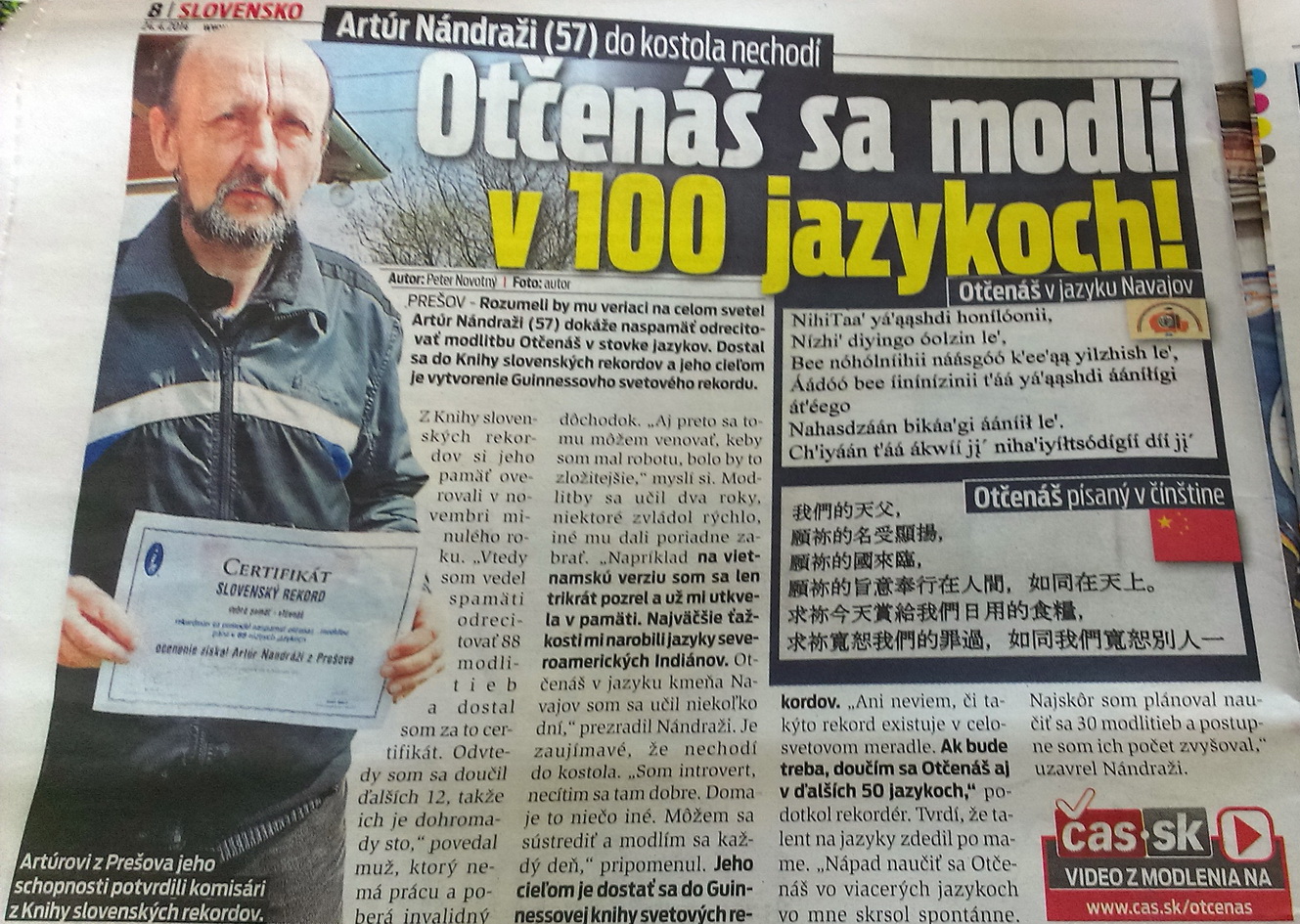
This was the prayer taught by Jesus Christ as a model for addressing God the Father. I would like to mention several facts connected with this prayer, because many of them were, and still are, important to me. I will go back to February 2012, although unfortunately I no longer remember the exact date. I was talking with my elder son Oto at his home about family matters when I suddenly changed the subject and told him that I was going to learn the Lord's Prayer in at least thirty languages and that I would like to become a Slovak record holder. I added: “I hope nobody in Slovakia can recite this prayer in more than ten languages.” He laughed and said: “Dad, there can't be a bigger idiot in this country than you! Who would learn that?” I asked him to download the versions of the prayer I wanted from the Internet and, where necessary, recordings of the correct pronunciation.
I had little difficulty with many languages, including Zulu, Xhosa and several other African languages. The same was true of many other languages of the world, although for some of them I naturally needed a transliteration. Some people may find it difficult to believe, but thanks to my strong visual memory I was sometimes able to memorise a prayer after reading it only once or twice. Portuguese, Basque and Zulu are examples, as are languages I had studied in the past. In March, serious health problems arose and the project had to be put aside for a time. I do not intend to describe all those difficulties in detail. There were many personal and external circumstances that sometimes prevented me from studying for longer periods.
I became especially fond of Navajo, the most widely spoken Native American language in North America, although I had some difficulty with it, partly because I was ill at the time. I can recite the Lord's Prayer in three Native American languages of the United States, and Navajo is the most fascinating of them to me. Nahuatl, also known as Aztec, was another language that required some effort. I should also mention Iñupiat, spoken by Inuit communities in Alaska and Canada. The prayer contains very long words; the longest has twenty-nine letters. Kalaallisut, or Greenlandic, belongs to the same broader linguistic area, and I learned that version surprisingly quickly. Chinese, Korean, Hindi and Georgian were comparatively easy for me.
I remember looking at an Arabic version of the prayer that had no Latin transliteration. My son asked me, “Dad, can you read that?” Oto knew that I had once studied Arabic. I stared at the script for a while and the Arabic letters gradually came back to me. Many years earlier I had learned Arabic, and suddenly I realised that I could read it again. My son later found another Arabic version with a transliteration. Although the wording was somewhat different, I discovered that I had made only two mistakes. I eventually memorised two Arabic versions of the prayer. Coptic Christians in Egypt and Arabic-speaking Christians elsewhere use somewhat different forms. Ah, languages! I love them, but that is another chapter.
I would very much have liked to obtain the Lord's Prayer in one of the languages of Nigeria. English is the country's official language, but it is home to around 250 ethnic groups. Christians predominate in the south and Muslims in the north; Yoruba and Igbo are among the largest indigenous languages. At the time I could not find suitable versions online. I also lacked versions in languages such as Malinke in Guinea and Kikuyu in Kenya. Papua New Guinea has hundreds of ethnic groups and languages, yet I could not find a version of the prayer from that part of the world. Australia likewise has many Aboriginal languages, but I obtained the prayer in only one of them, Keinyan. I would also have liked to find versions in languages such as Warlpiri, Pitta Pitta, Nyangumarta and Nunggubuyu, as well as Dzongkha from Bhutan, Dhivehi from the Maldives and Malagasy from Madagascar.
In some languages the Catholic and Protestant versions differ considerably; Swahili and Finnish are examples. There are also many English versions of the Lord's Prayer. I learned a traditional version after buying an English Bible, and my son also downloaded another version from the Internet. Scots, or Scottish English, is particularly interesting because several quite different forms of the prayer can be found online. I downloaded three such versions and memorised one of them.
I would also like to mention the Philippines, an Asian country with a very large Christian population and thousands of islands. Many ethnic groups and languages are represented there, and I learned the prayer in three Philippine languages that I was able to obtain. Indonesia is different, with a predominantly Muslim population and an enormous number of islands, ethnic groups and languages. I was pleased to learn the Lord's Prayer in Indonesian, Javanese and Sundanese. I was disappointed that I had not yet learned it in Thai because, although I had a transliteration at home, I was not completely confident about some points of pronunciation.
There were still many languages in which I wanted to find and memorise the Lord's Prayer. I was interested, for example, in languages of small Pacific states such as Nauru and Tonga, both of which have strong Christian traditions. At that time I had also been unable to find versions in Burmese, Lao or Khmer.
A friend once asked me: “What if somebody in Slovakia already knows the Lord's Prayer in at least ninety languages?” I replied that I did not believe it. At that time Nandráži officially knew the prayer in 88 languages; I jokingly told him that Artúr would beat that with 100, Nandráži would come back with 120, and Artúr would answer with 150. I have always needed a goal that keeps me motivated. I will put it plainly: I wanted to find out whether I might one day qualify for the Guinness World Records, provided nobody elsewhere had already achieved the same feat in more languages. Learning additional versions would not have been the main obstacle; I had heard that an official record application could also involve costs. In any case, I never assumed that my total must be a world record. Somewhere in the world there is almost certainly another person with a similar passion.