Chess, one of the oldest, most ingenious and most fascinating games, entered my life very early. On my fifth birthday my father gave me a wonderful present: a magnetic chess set. He immediately began teaching me this beautiful game. About a week earlier he had told me the famous old story, known to many chess players, about the invention of chess and the grains of wheat placed on the sixty-four squares of the board. In the story, a ruler promises a reward to the man who has introduced him to the game: one grain on the first square, two on the second, four on the third, always doubling the number until the last square. Only then do the mathematicians discover that the amount of grain required is unimaginably large.
I loved that story, and I quickly fell in love with the game as well. I learned how the pieces move and the very next day my father and I played our first game. Of course I lost. One piece after another disappeared from my side of the board until only my king remained, and I began to cry. That is something I will never forget. I lost the next few games too, although not quite so badly.
My late father knew the basic rules and could play a little, but he was not a strong player. Within about a week I was already beating him decisively. He did not know chess theory, strategy or tactics in any depth, so there was only so much I could learn from him. Even so, I was proud that before long I was able to teach the game to boys of my own age and even to older boys. Most of my friends were not interested in chess, but I still taught quite a few people to play.
I was surprised that in our village of roughly seven hundred inhabitants almost nobody knew the game. Fortunately, my best friends on our street—twins Julko and Lacko, who were a year older than I was, and Janko, who was two years older—also came to like chess. We played almost every day, often outside on a bench in front of the house. Where have those wonderful years gone? Before chess, we mostly played cards. I inherited my liking for cards from my grandfather. From the age of about twelve I enjoyed playing rummy and later canasta. My grandfather had actually taught me cards when I was about four; my grandmother nearly killed him for it. I was never a gambler.
At primary school I was among the best chess players, and I still remember games against my class teacher and the headmaster, with mixed results. One year at secondary school I became the school chess champion. Sixteen of us started in a knockout competition. I reached the final, which was played as a best-of-three match, and I won 2–1. It was unforgettable. Until then the school had never organised such a championship. As a secondary-school student I also began buying chess books. At both primary and secondary school I took part in district team championships almost every year.
I should also mention my godfather, a cousin of my father's from Kameňany who later lived in Prakovce. He was a chess player and visited the village every summer during his holiday. I will never forget our games; I learned something from him as well. At about fifteen I became interested in chess composition and began solving chess problems published in Nedeľná Pravda. I was enormously happy whenever my name appeared among the prize winners for a correctly solved problem. Solving competitions were especially exciting. I clearly remember one four-move problem that I worked on until two o'clock in the morning when I was a grammar-school student. The important thing was that I solved it.
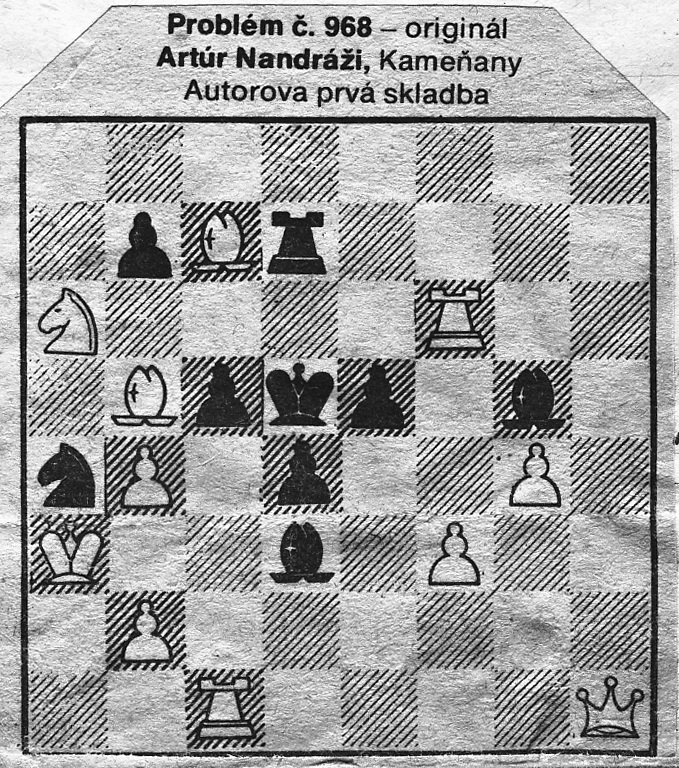
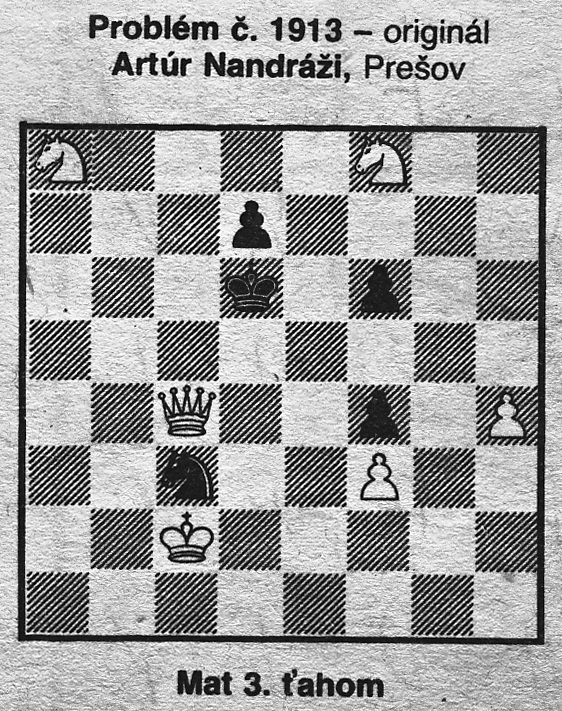
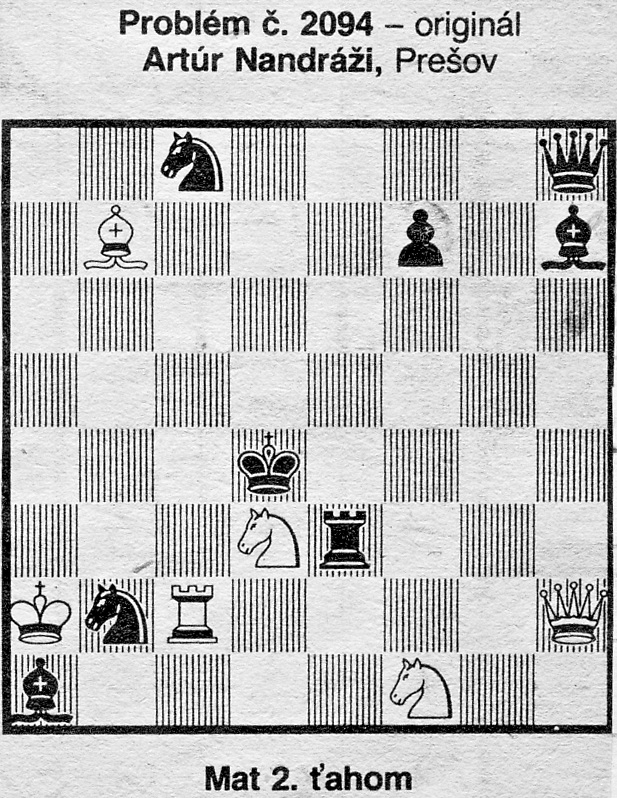
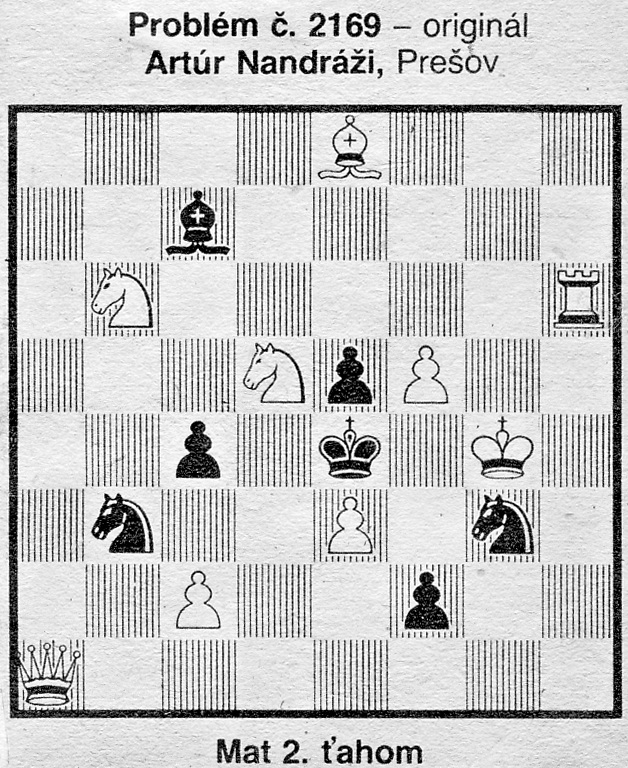
In 1978 I began composing chess problems myself. On 3 March 1978, thanks to B. Formánek, one of my own compositions was published in Pravda; I had composed it about a month earlier. In total, more than thirty of my compositions appeared in Nedeľná Pravda and Východoslovenské noviny. I did not compose a huge number—perhaps around eighty altogether. I wanted to place my first published composition and several others on this website. If I remember correctly, my last published problem appeared in 1996. Health and family difficulties eventually caused me to stop both composing and playing competitive chess for a time.
In 1978 fate brought me to Prešov, where practical chess was played at a much higher level. Over the years, with some interruptions, I played for ZPA Prešov, Autobrzdy Prešov and, from around 2005, Slávia PU, the club of the University of Prešov. I may be mistaken about the exact year. I was listed for the A team in the 2nd League, the B team in the 3rd League and the D team in the 4th League.
My greatest chess success was an unforgettable fifth place at the international Prešov Open in 2012. It surprised everyone. I scored 6.5 points out of nine against a field of about fifty players in a nine-round Swiss-system tournament. I managed to defeat players whose ratings were higher than mine. I was convinced that I would probably never achieve anything better, although I hoped I was wrong. What made the result even more remarkable to me was that, within a few days, exactly fifty years had passed since I first learned to play chess. Life can be very unpredictable.
I also taught both of my sons to play. My younger son, Dominik, became an active chess player; my older son, Oto, never developed the same affection for the game. When I returned to competitive chess after a long break I effectively started again from the bottom, with the lowest rating—if I remember correctly, around 1000 ELO. Gradually my rating rose and, after the season described in the original text, it stood at 1837. I still had goals and motivation to play well despite frequent health difficulties. I hoped to play the Prešov Open again and wanted to reach at least 1855 ELO.
Some memorable games
The original Slovak chess notation from the source is preserved below. Only the accompanying comments have been translated.
Game 1: White: A.N. – Black: Dominik Nandráži (PŠK Dason Prešov “B” – Slávia PU Prešov “D”, 4th League). Played on 11 March 2011.
1.Jf3 - d5 2.c4-dxc 3.Da4+ - Jc6 4.Dxc4 - e5 5.d3-Sb4 6.Sd2 (I probably should have played Jc3)-Se6 7.Db5-Sxd2 8.Jbxd2-Dd5 9.Dxd5 (I could have taken the risk and played Dxb7) -Sxd5 10.a3-f5 11.g3-Jf6 12.Sg2-0-0 13. O-O-e4 14.dxe-fxe 15.Jg5-Vae8 16.e3-h6 17.Jh3-g5 18.Vfc1-Jg4 19.Vc5-Jf6 20.Vac1-Ve6 21.Sf1-b6 22.V5c3-Vd8 23.Sb5-Je5 24.Vxc7 (a pawn sacrifice for the attack)-Jd3 25.Sxd3? (I should probably have played Vc2 instead)-exd 26.Vxa7-Je4 (that passed pawn looked very dangerous to me) 27.Vcc7-Vc6 28.Vxc6-Sxc6 29.Jb1-d2 30.Jxd2-Vxd2 31.f3-Vd1+ 32.Kg2-Jd2 33.e4-g4 34.fxg-Jxe4 35.Jf4-Vd2+ 36.Kg1-Vd1+ 37.Kg2-Vd2 38.Kg1-Jg5 39.b4-Sg2 (I did not expect that!) 40.Jxg2-Jh3+ 41.Kf1-Vf2+ 42.Ke1-Vxg2 43.Vb7-Vg1+ 44.Ke2-Vg2+ 45.Kf3 ...
After 72 moves I resigned. In the popular expression, the son had made mincemeat of his father.
Game 2: White: A.N. – Black: J. Košela (Slávia PU “B” – Slávia PU “A”, 3rd League, 11 April 2010). If I remember correctly, our A team was promoted to the 2nd League that season.
1.c4-e5 2.Jc3-Sb4 3.g3-d6 4.Sg2-Se6?? (touch-move; this was a disaster for Black) 5.Sxb7-Jc6? (another weak move; he should have played Jd7, but he probably did not handle the situation well) 6.Sxc6+-Sd7 7.Sxa8-Dxa8 8.Jd5-Dc6 9.Db3-a5 10.a3-Sc5 11.Db8+-Sc8 12.Dxc8++
Checkmate. This was the shortest competitive game of my entire chess career.
Game 3: one of my longest and, in my opinion, most beautiful games. I have played games approaching one hundred moves, but this one remains especially memorable. White: A.N. – Black: J. Brodzák (Bardejov “B” – Slávia PU “B”, 3rd League, 8 February 2014).
1.c4-c5 2.Jc3-Jf6 3.g3-Jc6 4.Jf3-g6 5.Sg2-Sg7 6.0-0 - 0-0 7.d3-d6 8.Vb1-Je8 9.e4-e5 10.Sg5-f6 11.Se3-Se6 12.a3-a5 13.Jd5-Sxd5 14.cxd-Jd4 15.Sxd4-exd 16.Db3-Vf7 17.Sh3-Ve7 18.Jd2-a4 19.Dd1-b5 2O.f4-Vea7 21.f5-g5 22.Sg4-Sf8 23.Kh1-Jg7 24.h4-h6 25.hxg-hxg 26.Vf2-Je8 27.Sh5-Vh7 28.Vh2-De7 29.Sg6-Vxh2 30.Kxh2-Dg7 31.Kg2-Dd7 32.Dg4-Dg7 33.Vh1-De7 34.Sh7+-Dxh7 35.Vxh7-Kxh7 36.Dh5+-Kg8 37.Dg6+-Sg7 ...
We played a total of 76 moves and the game ended in a draw.
Game 4: one of the games I value most from my successful Prešov Open tournament in 2012. I managed to defeat an excellent, highly rated player against whom I had already lost twice. White: M. Vrábeľ – Black: A.N., round 7, 2 August 2012.
1.Jf3-Jf6 2.c4-c5 3.g3-b6 4.Sg2-Sb7 5.0-0 - g6. 6.Jc3-Sg7 7.e3-d6 8.d4-cxd 9.exd-Jbd7 10.b3-0-0 11.Sb2-a6 12.De2-e6 13.Vac1-Ve8 14.Vfd1-Vc8 15.a4-Dc7 16.Jh4-Sf8 17.Dd3-Sxg2 18.Jxg2- Db7 19.Je3-d5 20.f4-dxc 21.bxc-Ved8 22.De2-Je4 23.Dg2-Jd6 24.Dxb7-Jxb7 25.Je4-Jd6 26.Jd2-Jf5 27.Jxf5-exf 28.Kg2-Ve8 29.Ve1-Sb4 30.Vxe8-Vxe8 31.Sc3-Sxc3 32.Vxc3-Ve2+ 33.Kf3-Vxd2 34.c5-bxc 35.dxc-Kg7 36.c6-Jb6 37.c7-Jc8 38.Ke3-Vd6 39.a5-Kf8 40.Vb3-Vc6 41.Vb7-Ke7 42.Kd4-Kd7 43.Kd5-Vxc7 44.Vb8??-Je7+
White was forced to resign because the rook would be lost. I will remain with that tournament for one more moment. After the first three rounds I had only one point. In the remaining six rounds I scored an unbelievable 5.5 points. It still feels good to write that.
My son Dominik sometimes came to visit me and we would play twenty blitz games in one sitting, with only five minutes per player for the whole game and a chess clock on the table. Blitz was very much his speciality. Thanks to the computer he played a great many games every day. Out of twenty games I might win one or two, draw perhaps three or four, and lose the rest. A catastrophe from my point of view. It annoyed me immediately after the match, but otherwise I was happy that he played so well, and I always supported him when he played competitive games during the season. I only regretted that we did not play for the same team.
I am also proud that during my life I had the opportunity to play simultaneous exhibitions against Slovak grandmasters: J. Plachetka, probably in the late 1970s, and Ľ. Ftáčnik, sometime in the first half of the 1980s. It was usually clear by around the fifteenth move that I was going to lose, but the result was never the important part of those experiences.
Long live chess!
Update
From 26 July to 2 August 2014 another important Prešov Open tournament was held in our city. Shortly before it began I developed health difficulties that I will not describe here. I would, however, like to mention that I played the entire tournament standing up, which was a significant disadvantage. I do not want that to sound like an excuse. Had the tournament not been so important to me, I would not have played at all.
Before the event I set myself two goals. Because of my difficulties, I wanted to score at least four points and I hoped to raise my rating to 1855. In nine rounds I scored 4.5 points: three wins, three draws and three losses. The new rating was due to be published on 1 September 2014, so at that point I still had to wait to see whether the second goal had been achieved.
On 3 September 2014 my younger son Dominik downloaded the new ratings. They surprised me more than I expected: my rating had fallen by 22 ELO points to 1815, and my son's rating had fallen even more. It did not matter. A new chess season would soon begin and both of us would have another opportunity to fight for results that would satisfy us by the end of the season.